Better Late…

A friend suggested that I consider happier, perhaps even funny, posts. The idea made me chuckle because the reason I started the blog was to share my experiences surrounding overwhelming grief.

“You can still make them observational,” the friend suggested. He has a point. At the very least, it can be an exercise in strengthening one’s writing muscle.

I do seem to go for the emotional jugular.

Matters ranging from the meaning of politics to reasons for crime and belly aches were openly and eagerly discussed in my household. We were loud, sometimes angry, often opinionated. It was fabulous.

Our large and tightly-knit family on my mother’s side was where we spent (almost) every holiday from Rosh Hashana to Thanksgiving, from Chanukah to Passover. My grandmother was a Polish immigrant with piercing blue eyes who once was stylish and beautiful. She was married to the man I always considered to be my grandfather, even though he had married in after my actual grandfather died and was of no blood relation to any of us.

He was, however, a supporter of my writing at a time when I appreciated the recognition, long before the idea of becoming a writer entered my consciousness. He listened to poems of protest and puppy love, and responded with gentle critiquing and praise. In oddly pronounced English, he told me to keep writing. He was an immigrant like my grandmother. I loved his funny sounding Russian accent and word formations. But Grandpa Joe’s impact was serious. He understood parts of me better than my blood relations.

Grandma Sarah spoke in broken English sprinkled with bits of Yiddish and Polish, so that you got the main idea of her communications without needing to understand her every word. What proved to be eminently clear was her enormous heart which produced soft hugs, blanket cuddles, mushy face kisses, lap naps and of course her trademark brand of love; feeding us delectable ethnic morsels that delighted the tongue and tummy.

Her style of English didn’t hamper understanding unless she was giving the memory inspired specifics of a recipe for say, challah, which my cousin and I badly botched the yeast amounts for. The loaf grew to quadruple the size of any challah I have ever seen. When it pushed the oven door open, we knew trouble had found us. We watched a loaf of bread grow to gargantuan heights and widths. Breads should not have the capacity to open oven doors on their own, to say nothing of the horrified look on my grandmother’s round, usually peaceful, face.

Eventually my cousin and I reacted as we usually did to situations beyond our control – we doubled over and roared with laughter as we watched my grandmother stare at the stove, shuckling (shaking) with both hands glued to her head, while the ever-expanding, over-doughed, excessively-yeasted challah grew into something that could be used as a lethal weapon.

Grandma Sarah was stoic, and she wasn’t finished attempting to impart knowledge in the art of cooking to her only granddaughters. She wanted to teach us, perhaps by way of salvation, to make kreplach; dumplings filled with meat or potatoes, usually found in soup, and particularly delicious. If you haven’t tasted them, add them to your bucket list. Immediately.

In order for this to occur you must: find a Jewish grandmother from the old country who isn’t dead, who cooks with proper ingredients, and uses no formal recipe (just dashes, pinches, and improv). This is not an impossible feat, these women are rare but not extinct. The warm soup and triangular dough stuffed with filling is nourishing on a physical and soul level. There is nothing like food cooked with love.

Which is why my grandmother got very upset with my cousin and me, when she showed us, after the challah fiasco, how to close the kreplach dough by mushing it gently between our thumb and middle finger, in dips similar to the perimeter of a pie crust. We didn’t squeeze tenderly enough for her sensibilities, and unwittingly added insult to this serious endeavor by giggling incessantly. She felt we weren’t respecting the food and the process. We weren’t. She didn’t get it. Neither did we.

Yet, take notice of how the experiences stick with me forty years later. Thank you grandparents for your roles in my life. And now, grandma, I do get it.


Posted in Uncategorized | Leave a comment

Let’s Get Personal

Loss, painful as it is, has the power, the force, to break us open in transformational ways. That same power and force – because of its dependence upon an individual’s interpretation of a situation – can shut us down so completely that our growth may be stifled for surprisingly long periods of time, in a myriad of ways.

IMG_0316

Love locked.

My stifling started at the age of three, when my parents fought, disliked one another vehemently, and divorced. In a time when few did. The world I knew fell away and to remain in it, I built walls.

I do not blame my parents who were involved and loving, hurting me was not on the agenda, the world was crashing for them too. It was a sad and painful time in which we had to cope. We tried to be mindful, but with emotions popping like firecrackers, I’m not sure to what degree we were.

We have all experienced loss in some form, and at early ages. The degrees of relationship may change, the feelings of intensity may vary. A sure sign of fakery and shallow intention is to behave aggrieved for the benefit of others who are watching. Some of my most intense, and genuine, tears were shed in my bed in the early morning with only the dawn as a voyeur to my anguish.

I preferred it that way. It was embarrassing to share those immensely intimate moments with others, even those closest to me. The moments felt raw, vulnerable, and I didn’t know when, or if, they would end. It was difficult for me to view them in myself.

But there is an energy to melancholy, to grief, to gripping loss that wrenches us from any automatic pilot we have perfected. It narrows our lens to what is in front of us, what screams to us, without judgments of good and bad. No matter how hard we pull away, pretend to ignore, or utilize creative thinking to believe we have it handled, its tug is unrelenting. And this is critical to our growth, and enrichment. It is our story, our voice, a pathway into the person we need to find. Which is, of course, ourselves.

It’s one of the reasons melancholy music resonates so. There is an insistence on presence through uprooting normal mental capacities. The music and lyrics find a vein, and mainline emotion. A fascinating way to drag us deeper, into the murky waters of what makes us tick. If we may be objective – consider the learning that takes place here.

Although not easy, staying in a moment that is demanding respect, creates the framework for grounding and rooting. It would have to. Flailing emotions need a foothold or – I swear – insanity could creep in. Like an oak tree that sways wildly but remains standing due to roots that drill into the ground, tendril by tendril, like an anchor.

There is a reason we experience the emotions we do. Individually certainly, it’s part of who we are. but also as a species. It grows us in the direction of love; heart, compassion, caring, empathy. Being a parent has a similar element that cranks open the heart. It is the pain and the caring, that knocks us from our current perspective, and slips us, without asking our permission, into another frame of reference. This slip can never be simulated.

You will know when the slip occurs, it’s undeniable. How ready you’ll be to let it wash over you is another story. Probably not very. Not right away. But it will remain vigilant. You must be strong and courageous to allow an opening, for it can be terrifying. My slip occurred when my parents’ died. Of course, there were smaller, less dramatic slips along the way. Those slips kneaded my heart muscle with tough love and rolling pins to make it practiced, pliable, and proficient.

Posted in Uncategorized | Leave a comment

Important, Urgent and Beyond

Life lessons have a genius to them, particularly the ones that won’t go away, those that clamor for continued attention, that are insistent upon our time.

One such lesson for me has been the differences between what I consider to be urgent and what I consider to be important. And when a situation is both, or neither.

I am a fire – put – outer, so I respond well and expediently to urgent.

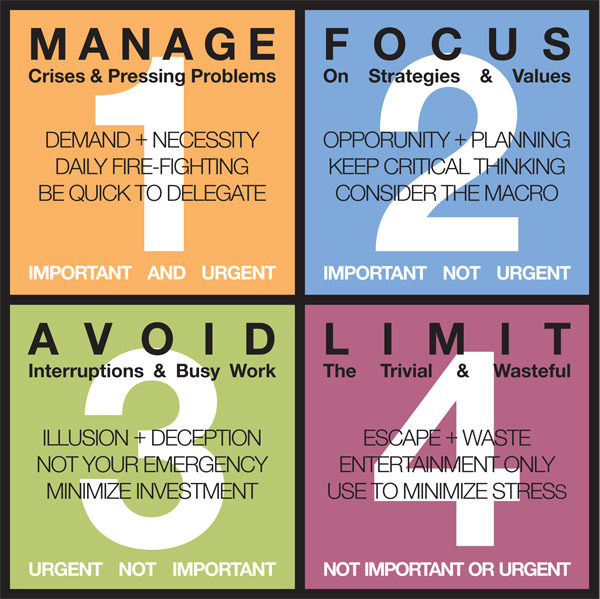
Steven Covey, in his books  The Seven Habits of Highly Effective People and First Things First advocates the use of four quadrants to determine what is urgent and/or important so that we may decide with intention what deserves priority status and what can wait.

Urgent-vs-Important.indd

Let us explore this further. Below find Steven Covey’s information as shared on Sid Savara’s blog:

Research Shows….

Not setting priorities is one of the 7 reasons people fail.

Here’s a picture and a brief overview.

Merrill Covey Matrix Four Quadrants Urgent Important

  • In Quadrant 1 (top left) we have important, urgent items – items that need to be dealt with immediately.
  • In Quadrant 2 (top right) we have important, but not urgent items – items that are important but do not require your immediate attention, and need to be planned for.  This quadrant is highlighted because Covey emphasizes this is the quadrant that we should focus on for long term achievement of goals
  • In Quadrant 3 (bottom left) we have urgent, but unimportant items –  items which should be minimized or eliminated. These are the time sucks, the “poor planning on your part does not constitute an emergency on my part” variety of tasks.
  • In Quadrant 4 (bottom right) we have unimportant and also not urgent items – items that don’t have to be done anytime soon, perhaps add little to no value and also should be minimized or eliminated.  These are often trivial time wasters.

Quadrant 4 – Not Urgent and Not Important

Clearly, not urgent, not important – and an obvious time waster.  Other time wasters include:

  • Mindless web browsing
  • Too much television/channel surfing for the sake of channel surfing

Quadrant 3 – Urgent and Not Important

My favorite examples, though I could have picked out more –

Other “Urgent” tasks that add little to no value

  • Phone calls that are off topic
  • Email that you have to reply to right away or it loses value (“Do you want some donuts? I have some in my office!”)

Quadrant 2 – Not Urgent And Important

Your overall health is something you may take for granted today, and may not see urgency in dealing with it – but long term, we know it’s of supreme importance.

There are some other important, yet not urgent, things that fall into this quadrant as well:

  • Exercise
  • Reviewing your career path
  • Maintaining relationships with family/friends

Quadrant 1 – Urgent and Important

Perhaps not entirely rational, but at least her priorities are in order.  Other examples:

  • Family Emergencies
  • Real, hard deadlines for important projects

Whew, A lot to take in and I don’t find the situations that real-life presents as easy to organize into quadrants. I get caught up in urgent-not important and in not urgent-important (quadrants 3 and 2 respectively). Stuff like completing all the items and phone calls on my ‘to do’ list so I can cross them out instead of giving an important person attention. Or thinking that not urgent but important means it must be done NOW, instead of quite the opposite. None of these decisions come from a callous heart, I am the too-sensitive empath, remember? For me there is a correlation between lots to do and anxiety. I do not (without mindful work) peek through the anxiety to prioritize. Mistakenly, everything seems of equal consequence until complete.

 I know – and I’m not proud of it. I admit to being knocked on the head, hard, a few times by my surrounding circumstances in order to remember what is what.

The good news is I’m learning and I’m better than I was decades ago.

Posted in Uncategorized | Leave a comment

April Come She Will

If you are too young to know who Simon & Garfunkel are (is there such a person?) or if you’ve never heard songs from their album (yes, it was an album) Sounds of Silence – may I present one of them. While it may not be current, it remains timely. The test of time is a quintessential sign of good music.

Take a listen. Beautiful, isn’t it?

Have a great day.


Posted in Uncategorized | Leave a comment

The Highly Sensitive

The ‘highly sensitive’ is an actual category of human being. I know – I’m one of them.

Elaine S. Aron wrote a book about this type called, not shockingly, The Highly Sensitive Person. Certain highly sensitive people are also considered empaths. And no, for you non-believers, I am not mistakenly using the word empath for empahy (I get asked that a lot). The words are similar but not identical in meaning.

Dictionary.com defines empathy as: the psychological identification with or vicarious experiencing of the feelings, thoughts, or attitudes of another.

But when you use your keyboard to type the word empath into Dictionary.com’s little blue box, it asks, beneath the blue box (almost in a scolding manner or at the very least as though you’ve made a mistake) –

Did you mean empathy?

Uh, no –  I meant what I wrote – EMPATH.

On the other hand, if you type the word empath into Google’s search bar, you have options populating straight down the page.

The first one listed states:

‘Being an empath is when you are affected by other people’s energies, and have an innate ability to intuitively feel and perceive others. Your life is unconsciously influenced by others’ desires, wishes, thoughts, and moods. Being an empath is much more than being highly sensitive and it’s not just limited to emotions.’

Sounds terrible, right?

In an article in – elephant journal, it’s about the mindful life – titled: Traits of an Empath,  Alex Myles writes:

‘The most striking thing for me about being an empath is the way I feel the physical, mental and emotional pain of others as though it were my own. This can be and has been emotionally and physically crippling and it has caused me to suffer tremendously. It is often described as being similar to a sponge, absorbing every emotion and piece of energy around me, and then becoming weighted down by it.

Learning about the empath personality type helped me greatly, as not only do I now understand myself better, I have also learned how to protect myself and not allow outside toxic energies, emotions or behaviors to affect me negatively.’

Bing! A way to protect ourselves in whatever situations we find ourselves sensitive in and reactive to. Good self-care advice for many.

I have been told, more than once and on good authority, that I react like an empath. In fact, one of the people who told me this, is listed fourth on that very same Google search mentioned above. Being an empath, if we take on faith that I am one, is remarkable and confusing, a bit like the rises and troughs of roller coaster riding. People laugh and scream, wave their hands wildly in the wind and white knuckle the safety bar that keeps them living. The ride is unpredictable and out of their control.

The  question for empaths is – since this ability (skill, trait?) is not cognitive or instinctive – how does one involve oneself with the people of the world and stay protected from them at the same time? With no steps to retrace and no thoughts to reconcile, it becomes a tough nut to crack. But life is meant to be lived, sometimes with a gingerly tip-toe, sometimes with great bounding leaps. No matter the path, it remains ours to traverse, with its warts, consequences and mistakes, and its blossoms, bonuses and successes. Life continually manages to find a way to surprise us.


Posted in Uncategorized | 4 Comments

Feelings

I’m cranky. And my back hurts. Sometimes seriously enough for me to take Advil, sometimes seriously enough that I can not sleep.

I first learned of this back issue in 2004 when I fell on black ice. Falling hard on my left hip, I made an appointment to see my orthopedist to make sure nothing was broken. After Xrays were taken, the doctor re-entered the room and said,

“It’s not your hip I’m worried about, it’s your back.”

“There’s nothing wrong with my back.”

“There is. You never knew about it because you’ve been asymptomatic, and it’s probably congenital, but something’s wrong with your L-4 and L-5 vertebra. The condition is called, spondylolisthesis. It’s a big word that basically means you have a forward displacement of vertebra.

“What?”

“The vertebra of your lower back go like this.” He grabbed his oft used, yellowing skeleton located on the cabinet to his left and manipulated the spine to look like my back. “Instead of like this,” he said, letting it slide back into its natural curvature.

It has taken a while to understand the idiosyncrasies of spondy. Like an allergy, there is an emotional component that plays a pivotal role. I dragged a heavy sette down two flights of stairs by myself. This is a bad idea for a person with back issues. I felt the pinch and ache of tightening muscles. But it wasn’t until my cousin in Florida had a thyroid biopsy for a problem that’s proven tricky and my cousin in New York was admitted to Columbia Presbyterian Hospital for pulmonary blood clots, that my back started screaming.

I try to hide my feelings from myself by remaining rational and in an attempt to spare myself. Emotions are messy and confusing but suppression carries its own level of dysfunction. I don’t like looking at loss head on, even the possibility disturbs my equilibrium. I may suffer from PTSD in this regard, stemming from my early days. Which would help to explain my manner of dealing. To say nothing of the fact that my mom had an operation in New York at Columbia Presbyterian, and my dad was in Florida, seeing more doctors than I have fingers.

A smart, aware person can see their mistakes and learn from them, alter behaviors, change outcomes. But this is not the first time I’ve done this, and automatic pilot takes over in these instances. Until my back hurts enough to remind me to feel, causing the slow process of healing and presence to engage.


Posted in Uncategorized | Leave a comment

Ramblings of…

Many bloggers recycle their blogs. As a recycling enthusiast, I thought this a wonderful concept. So I began looking through some of my older posts. I got through very few however, because – although I enjoy rereading my writing, I found I wasn’t quite there anymore.

Does this mean I’m enlightened? Hardly. But it does mean I’m in motion. My life is fluid, the opposite of stuck. And busy. Which puts me in the position of having to think of something that is going on each week that pulls on me enough to want to share it.

I was quite prolific when in the throes of grief, or on a splendid vacation – but it is harder for me to share the mundane aspects of daily life, because they don’t register as worthy enough on my Richter scale.

Do I want to share that it is problematic for my GPS to locate the library that my New Haven writer’s group meets at, therefore I’m interested in changing the venue? Or that the girlfriend of my second son found a new job she loves? Or that my first son and his fiance are marrying in July, and contemplating the purchase of a franchise?

While all of the above hold import and promise, in order to write a blog about any of them, it would depend on how I was affected.

Because, selfishly or otherwise, this is  Wendy Karasin’s baby boomer musings blog.

What is next for me? In July I will become a mother in law. Eventually also a grandmother – now that is big! and I’m certain I’ll have a great deal to say about that. And with four offspring, that will likely happen more than once.

I also hope to publish smaller pieces – poems, personal essays, prose. Although this does present a challenge as I find myself beset with possible publications, whether they are good for me, whether I will be rejected by them.  Although this remains a big part of a publishing writer’s life, it always stings a little.

I have rambled enough for this Monday morning.

Posted in Uncategorized | Leave a comment